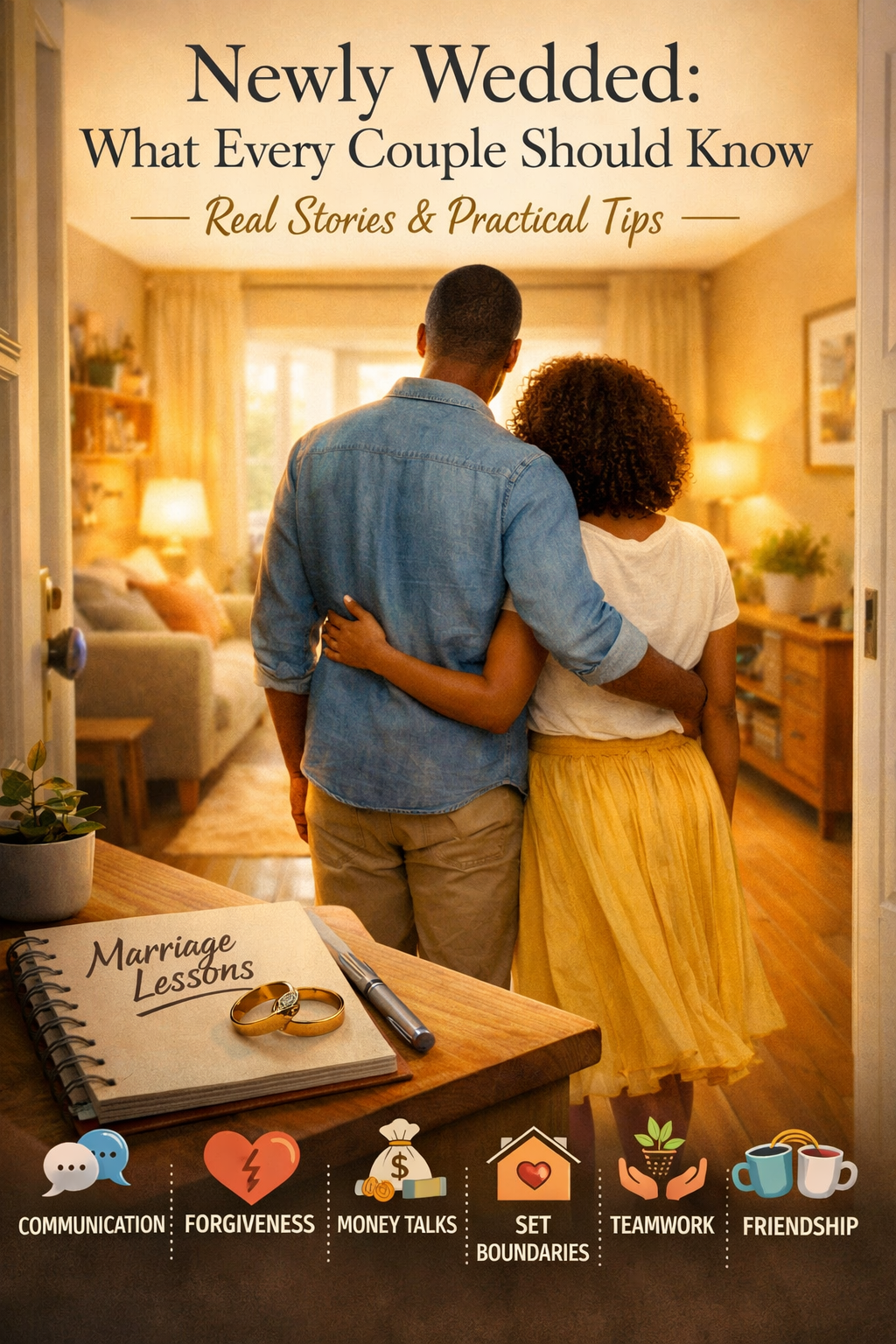
The Marriage Truth You Learn With Time: What Really Keeps Two People Together
INTRODUCTION: THE REALITY BEHIND “HAPPILY EVER AFTER”
Most people grow up with the idea that marriage is what happens after love proves itself strong enough. Movies show two people falling deeply in love, overcoming one or two obstacles, and then sealing it with a kiss. After that, the screen fades, and the story ends.
But real life begins after the wedding.
Marriage is not a fairytale.
It is not a perfect picture.
It is not a smooth road free of storms.
Marriage is a daily choice — a choice two imperfect people make to build something meaningful, something lasting, something bigger than individual ego and pride.
The truth many couples discover later in life is simple:
Marriage grows not because two people are perfect, but because they both choose commitment over convenience.
It is a partnership.
A journey.
A lifelong classroom where both husband and wife learn, unlearn, grow, and evolve.
This long-form article explores the deep truths couples discover about marriage, the challenges that shape relationships, and the lessons partners must learn if they want a union that lasts.
CHAPTER 1: LOVE IS THE STARTING POINT — BUT NOT THE FOUNDATION
Love brings two people together, but it doesn’t keep them together.
Love is an emotion; marriage is work.
Love feels good; marriage demands effort.
Many couples enter marriage thinking, “As long as we love each other, we will be fine.”
But life teaches a different truth:
Love is a flame, but the true foundation of marriage is partnership.
Partnership means:
Showing up even when you’re tired
Listening even when you’re frustrated
Staying calm even when you feel misunderstood
Choosing forgiveness even when it’s easier to shut down
Love may inspire these actions, but it cannot replace them.
Why love alone is not enough
Because life changes people.
Careers happen.
Bills happen.
Children happen.
Health challenges happen.
Unexpected storms happen.
And all these things test a marriage more than “love” ever could.
What saves a marriage is not the strength of the romantic feelings but the strength of the daily decisions.
Love chooses.
Ego reacts.
Pride destroys.
Marriage is choosing your partner repeatedly — not only on the good days, but especially on the difficult ones.
CHAPTER 2: “WE ARE ON THE SAME TEAM” — THE MINDSET THAT HOLDS MARRIAGES TOGETHER
Every strong marriage has one central belief:
We are not enemies.
We are partners.
We are on the same team.
This seems simple, but the lack of this mindset is why many homes break.
Arguments are unavoidable.
Disagreements are normal.
Misunderstandings happen even in the best relationships.
But when a couple sees each other as opponents, everything becomes a battle:
Who is right
Who should talk first
Who apologises
Who wins the argument
Marriage is not a boxing ring.
It is not a competition.
It is not a scoreboard.
The moment you start keeping score, you have already started losing something deeper — the unity that makes a marriage thrive.
Healthy couples fight the problem, not each other
Instead of:
attacking the person
raising their voice
walking away in silence
proving a point
They do this:
calm down
listen
express feelings respectfully
look for solutions
compromise
This is partnership.
This is maturity.
This is how love survives the test of time.
The truth is simple:
The goal of marriage is not to win arguments — it is to win peace.
CHAPTER 3: PRIDE VS. PARTNERSHIP — THE BATTLE INSIDE EVERY HOME
Pride is one of the silent killers of marriages.
It doesn’t show up suddenly.
It builds up slowly — through unspoken hurts, small resentments, and unaddressed misunderstandings.
Pride says:
“I won’t apologise first.”
“They should know how I feel.”
“I’m tired of always being the one trying.”
“If they really cared, they would figure it out.”
Partnership says:
“Peace is more important than ego.”
“Let me communicate clearly.”
“I care about us, not about winning.”
“Let’s fix this together.”
The moment pride enters marriage, love starts losing
No relationship can survive when both partners wait for the other to fix things.
No marriage thrives when nobody wants to take responsibility.
No home remains peaceful when “winning” becomes more important than understanding.
The strongest couples apologise fastest.
Not because they are weak,
but because they value connection over ego.
Pride separates.
Humility connects.
CHAPTER 4: COMMUNICATION — THE HEARTBEAT OF A STRONG MARRIAGE
Communication is more than talking.
It is understanding.
It is listening.
It is being emotionally available.
It is being open, honest, and gentle.
Most marriages do not fail because of lack of love —
they fail because of lack of communication.
Poor communication sounds like:
“I’m fine.” (but they are not)
“Do whatever you want.” (said in anger)
“You should know how I feel.” (mind-reading expectations)
Silent treatment
Talking only to reply, not to understand
Healthy communication looks like:
“Here’s how I feel…”
“Can we talk about this later when we’re calm?”
“I didn’t like how that made me feel.”
“Let’s find a solution together.”
“How can I support you?”
When couples learn to talk without attacking and listen without defending, everything changes.
CHAPTER 5: THE TRUTH ABOUT CONFLICT IN MARRIAGE
Many couples think conflict means the relationship is failing.
That is wrong.
Conflict is not a sign of a bad marriage.
Avoiding conflict is.
Arguments reveal:
Stress points
Differences in communication style
Unmet needs
Hidden expectations
The problem is never the conflict —
the problem is how the couple handles it.
Unhealthy Conflict Behavior
Shouting
Insults
Slamming doors
Walking out
Blaming
Bringing up old mistakes
Silent treatment
These patterns build emotional distance.
Healthy Conflict Behavior
Lowering your voice
Staying in the room
Focusing on the current issue
Taking breaks when overwhelmed
Apologising
Compromising
Every conflict gives partners a chance to grow closer —
IF they handle it with wisdom.
CHAPTER 6: EMOTIONAL INTIMACY — THE CONNECTION BEYOND PHYSICAL TOUCH
The strongest marriages are not built on physical attraction alone.
They are built on emotional intimacy.
This means:
Feeling safe
Feeling seen
Feeling supported
Feeling understood
Feeling valued
Without emotional intimacy, a marriage becomes:
cold
distant
transactional
lonely
Many couples sleep under the same roof but feel like strangers.
Not because they do not love each other
but because they stopped connecting emotionally.
Ways couples build emotional intimacy
Talking about the day
Asking how the other person feels
Sharing private fears
Encouraging dreams
Supporting goals
Spending intentional time together
A marriage thrives when partners stop being roommates and return to being companions.
CHAPTER 7: MARRIAGE SEASONS — WHAT EVERY COUPLE MUST UNDERSTAND
No marriage stays in one season forever.
There will be seasons of:
romance
peace
progress
success
joy
But there will also be seasons of:
stress
misunderstanding
distance
financial pressure
family challenges
uncertainty
A mature marriage doesn’t fall apart during the hard seasons.
Instead, it adapts.
The couples who last understand this truth:
Marriage is not always 50/50.
Some days it’s:
80/20
60/40
90/10
When one partner is weak, the other becomes strong.
When one is tired, the other supports.
When one is hurting, the other comforts.
Marriage is a lifelong exchange of support.
CHAPTER 8: THE ART OF CHOOSING EACH OTHER DAILY
At the core of every strong marriage is a simple but powerful commitment:
I choose you — today, tomorrow, and every day after.
No matter the storms.
No matter the challenges.
No matter the misunderstandings.
Love may begin the relationship,
but commitment keeps it alive.
Choosing each other daily looks like:
Protecting each other’s peace
Prioritizing time together
Respecting each other’s boundaries
Trusting each other fully
Forgiving quickly
Letting go of grudges
Supporting dreams
Laughing together
These small daily choices create the big picture of a strong marriage.
CHAPTER 9: WHAT MAKES MARRIAGE BEAUTIFUL
Marriage becomes beautiful when:
two people feel safe with each other
they laugh more than they argue
they communicate more than they assume
they forgive more than they blame
they grow together, not apart
Marriage becomes a blessing when both partners find comfort in each other’s presence, not fear.
Marriage becomes meaningful when you look at your partner and know: “This is my safe place. This is my person. This is my team.”
CHAPTER 10: LESSONS MARRIAGE TEACHES YOU
Patience is more important than perfection.
Your partner is not your enemy.
Communication will save you more than love will.
A gentle tone prevents more damage than a loud voice.
Your marriage grows when your pride reduces.
You can disagree and still respect each other.
Forgiveness is a daily practice, not a one-time event.
Small acts of kindness matter more than grand gestures.
True intimacy is emotional, not just physical.
It takes two committed people to build something that lasts.
CONCLUSION: MARRIAGE THRIVES ON WILLING HEARTS
In the end, the truth is simple:
You don’t need a perfect partner —
you need a willing partner.
Someone willing to talk.
Willing to listen.
Willing to grow.
Willing to stay.
Willing to love you through the storms.
Marriage is not about finding someone who never hurts you.
It’s about finding someone who values you enough to fix it when they do.
When two people choose partnership over pride,
communication over silence,
and unity over ego…
That is when marriage truly begins to flourish…💪💪💪💪💪.